15
October
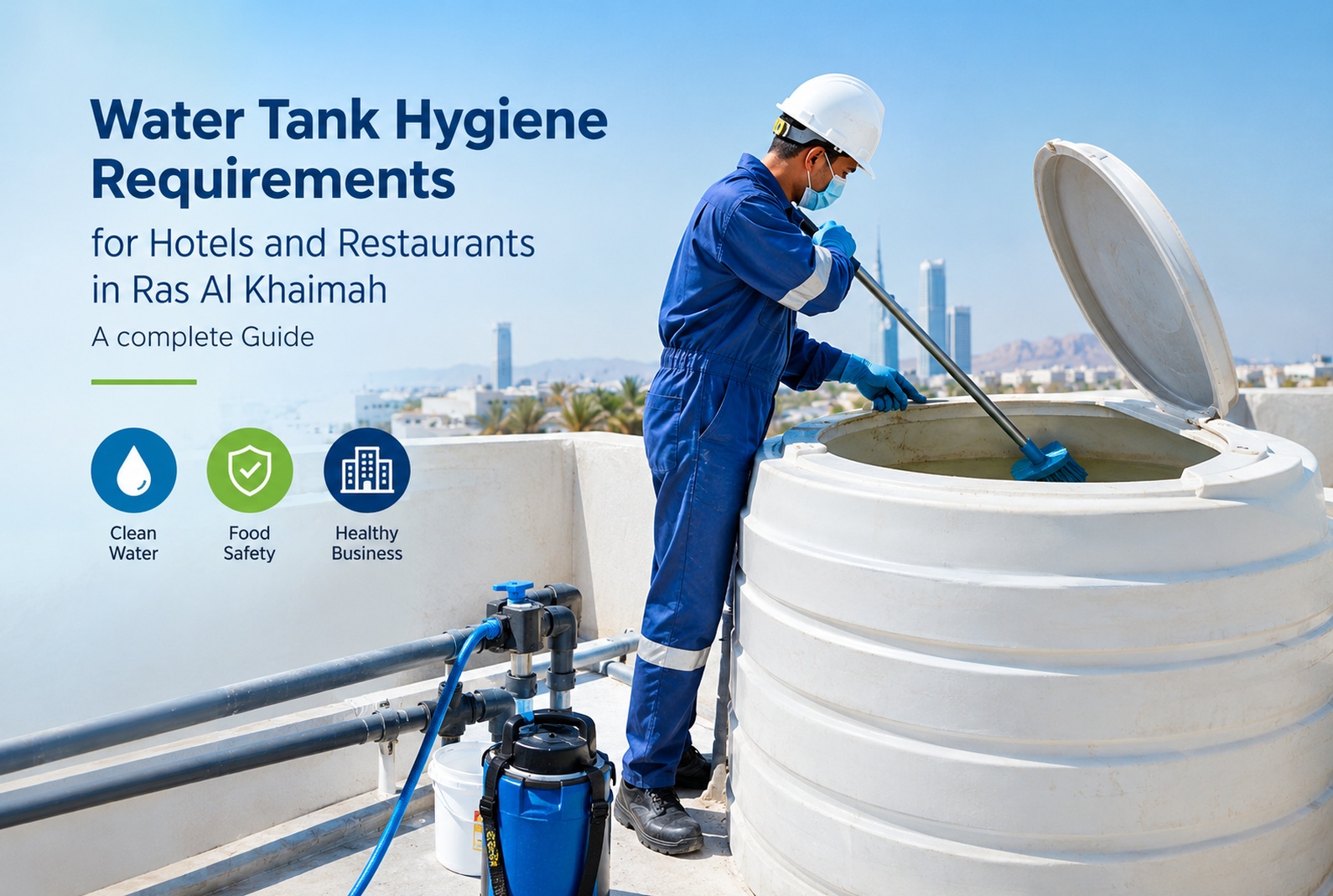
For hotels, restaurants, cafés and catering establishments in Ras Al Khaimah, water hygiene is an important part of maintaining food safety and operational standards. Water used for drinking, food preparation, cleaning and food- contact applications needs to meet applicable water-quality requirements. One area that businesses should not overlook is the water storage tank. Sediment, organic deposits and other contaminants can accumulate inside tanks if they are not properly maintained. The Ras Al Khaimah Municipality Food Code states that water storage tanks, tankers and associated pipelines, where applicable, should be cleaned at least twice a year, using approved chemicals and methods or certified water tank cleaningcompanies, to ensure the quality and safety of water used by food establishments. For hospitality and food businesses, therefore, water tank cleaning should form part of a documented preventive maintenance and food-safety programme.
Hotels and restaurants depend heavily on a reliable supply of potable water. Water may be used for:
✦ Drinking water systems
✦ Food preparation
✦ Cooking
✦ Washing fruits and vegetables
✦ Cleaning utensils
✦ Cleaning food-contact surfaces
✦ Kitchen operations
✦ Handwashing facilities
✦ Guest facilities
✦ Staff facilities
The RAK Municipality Food Code states that potable water supplied to food facilities must come from an approved source and that water used as an ingredient, in contact with food or food-contact surfaces, or for relevant cleaning applications must meet specified UAE/GSO drinking-water quality requirements. A clean water supply therefore isn't simply a building-maintenance issue. For food businesses, it is connected to the wider food-safety system.
The Ras Al Khaimah Municipality Food Code provides specific requirements for potable water in food establishments. Under section 4.5.1, the code addresses potable-water supply, storage, distribution, filtration and disinfection. Importantly, section 4.5.1.4 states that: Water storage tanks, tankers and associated pipelines, where applicable, shall be cleaned frequently, at least twice a year, using approved chemicals and methods or by certified water tank cleaning companies. This requirement is particularly relevant to food establishments such as restaurants, cafés, catering operations and other businesses handling food. RAK Municipality's Food Control Section is responsible for controlling food establishments and ensuring compliance with applicable health requirements and standards. The municipality also publishes resources relating to approved water tank cleaning companies.
Businesses should always verify the latest municipality requirements and current approval status of a service provider before arranging work, because approval lists and certificates can have specific validity periods. RAK Municipality publishes its water-tank-cleaning company list through its Public Health Administration resources.
For food establishments covered by the RAK Municipality Food Code, the stated minimum frequency is at least twice per year. That means businesses should not wait until they notice dirty water, an unusual smell or visible sediment. A practical maintenance programme can include: Activity Recommended approach Water tank inspection Regularly Professional cleaning At least twice annually where the food- code requirement applies Disinfection As part of the professional cleaning procedure Visual inspection During maintenance and after cleaning Cleaning documentation Maintain records Corrective maintenance When cracks, leaks, corrosion or damage are identified Water testing Where required or considered appropriate based on risk The exact maintenance programme should take account of the property's water system, tank condition, usage and applicable regulatory requirements.
Even when water entering a property comes from an approved source, conditions inside the storage system can change over time. Possible deposits and contaminants include:
Fine particles can settle at the bottom of a storage tank.
Accumulated sediment and organic material can form deposits that require physical removal.
Light penetration and environmental conditions can contribute to unwanted growth in unsuitable or poorly maintained systems.
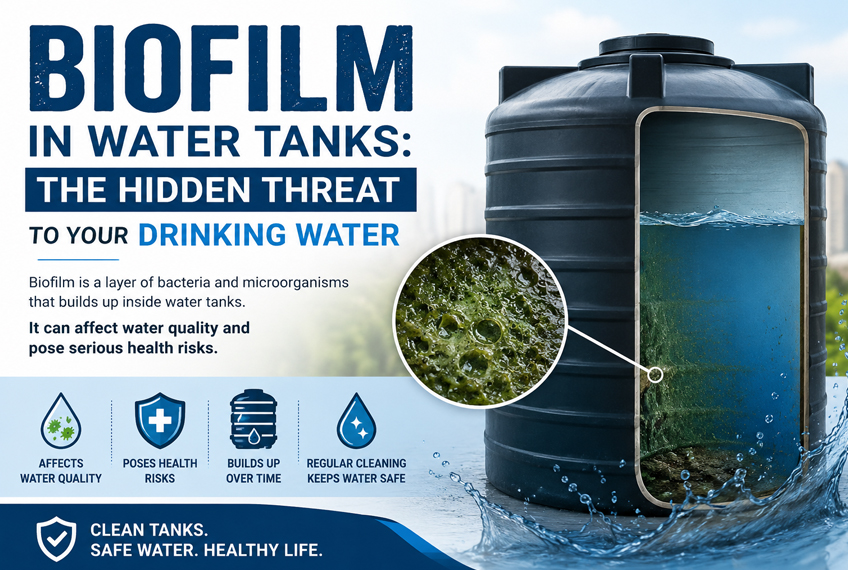
Microorganisms can form communities attached to internal surfaces. Stalwart's technical content highlights why established biofilm may require physical cleaning rather than relying solely on chemical treatment.
Deteriorating components can introduce particles into stored water.
Dust, insects and other debris can enter inadequately protected tanks. This is why simply looking at the water coming from a tap isn't enough to determine the condition of the inside of a storage tank.
Hotels may have a considerably more complex water system than a typical residential property. Depending on the property, there may be:
✦ Multiple storage tanks
✦ Large-capacity water reservoirs
✦ Several buildings or accommodation blocks
✦ Restaurants and commercial kitchens
✦ Staff accommodation
✦ Laundry facilities
✦ Guest bathrooms
✦ Swimming-pool-related systems
✦ Extensive distribution pipework
A hotel can therefore benefit from treating water-tank maintenance as part of its facility-management and preventive-maintenance programme. Cleaning should be planned rather than carried out only when a problem becomes visible.
Restaurants have an additional reason to pay close attention to potable water. Water can come into direct or indirect contact with food, equipment and food-contact surfaces. The RAK Food Code specifically states that water used as a product ingredient, in contact with food or food-contact surfaces, and for certain cleaning applications must meet specified physio-chemical and microbiological requirements. A restaurant's water-tank maintenance programme should therefore be coordinated with: Food-safety procedures Cleaning schedules Preventive maintenance Kitchen hygiene programmes Inspection preparation Facility-management records
A professional cleaning programme should be systematic. At Stalwart Solutions, the service process can be presented around four key stages:
The tank is inspected before cleaning. Technicians can look for: Sediment Sludge Algae Biofilm Corrosion Cracks Damaged surfaces Foreign material General tank condition The inspection helps determine the appropriate cleaning approach.
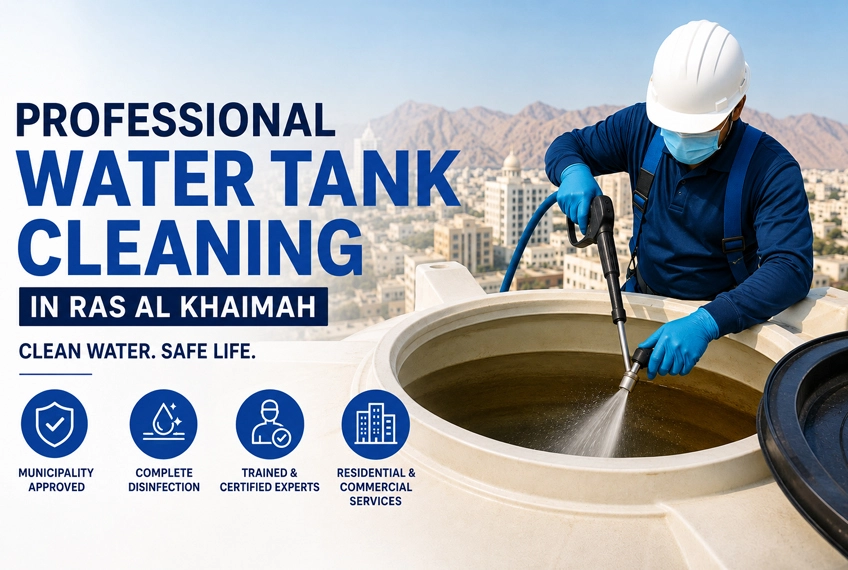
The tank is prepared and cleaned to remove accumulated deposits. Depending on the tank and site conditions, cleaning can involve: Draining the tank Removing sediment Manual cleaning Mechanical/physical cleaning High-pressure cleaning where appropriate Cleaning walls, floors and corners The objective is to physically remove deposits rather than simply treating contaminated surfaces with chemicals. Stalwart's published water-tank service information describes inspection, removal of sediment and debris, cleaning and disinfection as components of its professional service.
After physical cleaning, appropriate disinfection is carried out using suitable methods and chemicals. The choice and application should follow the applicable requirements and the specific tank/system conditions. The goal is to help control microorganisms and restore hygienic conditions within the storage system.
Documentation is particularly useful for commercial properties. A service report can record:
✦ Property details
✦ Tank identification
✦ Date of service
✦ Inspection findings
✦ Cleaning performed
✦ Disinfection performed
✦ Observations
✦ Before-and-after photographs
✦ Recommendations
✦ Completion documentation
Stalwarts published RAK service page states that its water tank service can include detailed inspection reporting and before-and-after photographs, with microbiological testing available through an independent accredited laboratory.
One common misconception is that adding disinfectant to a tank automatically makes the tank clean. Disinfection and cleaning are not the same thing. If sediment, sludge or established deposits remain attached to tank surfaces, chemical treatment alone may not remove the physical material. A comprehensive maintenance procedure therefore combines physical cleaning with appropriate disinfection. For established biofilm, physical removal is particularly important because the microbial layer can adhere to internal surfaces.
Hotels and restaurants should not wait for obvious problems, but certain warning signs can indicate that inspection is needed. Look out for: Cloudy water Unexpected turbidity or discoloration may indicate a water-quality issue. Unusual odour A change in smell should be investigated rather than ignored. Visible sediment Particles or deposits can indicate accumulation inside the storage system. Discoloration Brownish or unusual water may be associated with sediment, corrosion or other system issues. Damaged tank surfaces Cracks, leaks or deteriorated internal surfaces should be assessed. Long interval since the previous cleaning If there is no reliable record of the last professional cleaning, the maintenance history should be reviewed.
Restaurant managers can use this simple checklist as part of their maintenance planning:
☐ Confirm the tank location and capacity
☐ Review previous cleaning records
☐ Identify the water supply arrangement
☐ Schedule cleaning to minimise operational disruption
☐ Inspect tank access points
☐ Check for visible damage
☐ Drain the tank safely
☐ Remove sediment and sludge
☐ Clean internal surfaces
☐ Inspect corners and difficult-to-access areas
☐ Check for corrosion or damage
☐ Apply appropriate disinfection
☐ Rinse/restore the system as appropriate
☐ Conduct a final inspection
☐ Restore the water supply
☐ Record the service date
☐ Keep the service report
☐ Keep photographs/documentation where provided
☐ Record recommendations for repairs or further testing
Good documentation can make maintenance easier and provide useful evidence of preventive work. A commercial property should consider maintaining: Previous cleaning certificates/reports Cleaning dates Tank identification numbers Tank capacity Inspection findings Disinfection details Before-and-after photographs Water-testing reports, where applicable Repair records Contractor details Next scheduled cleaning date For food establishments, these records can form part of the property's broader food- safety and facility-maintenance documentation.
Hotels and restaurants should not select a contractor based solely on price. Before appointing a service provider, consider:
Confirm that the company and proposed service meet the requirements applicable to your establishment.
Large hotels, restaurants and catering facilities can have more complex systems than residential tanks.
Ask what the company actually does during cleaning and disinfection.
Check whether the company provides service reports and supporting documentation.
Commercial tank cleaning should be properly planned, particularly where tank access or confined-space hazards may exist.
Where risk assessment or operational requirements justify it, ask about microbiological testing through an appropriate laboratory.
If cracks, leaks, corrosion or damaged lining are identified, ask whether the contractor can provide or coordinate appropriate repair solutions. Stalwart Solutions also provides water tank repair and GRP lining services in Ras Al Khaimah.
Cleaning cannot solve every tank problem. If an inspection identifies: Cracks Leaks Damaged lining Corrosion Structural deterioration then repair or rehabilitation may also be required. Stalwart Solutions provides water tank repair and GRP lining services in Ras Al Khaimah for tanks requiring corrective maintenance. This makes it possible to address both hygiene and tank-condition issues as part of a broader maintenance programme.
Stalwart Solutions began operations in 2010 and states that water tank cleaning was one of its original specialist services. The company currently lists services in Ras Al Khaimah, including water tank cleaning and water tank repair. For commercial properties, Stalwart's service offering can include: Inspect → Clean → Disinfect → Report The company states that it serves residential, commercial and industrial properties and provides water tank cleaning and disinfection services in Ras Al Khaimah. For a hospitality business, the objective should be more than simply cleaning a tank once. A structured maintenance programme helps businesses keep their water systems under regular review.
The RAK Municipality Food Code states that water storage tanks, tankers and associated pipelines, where applicable, should be cleaned at least twice a year using approved chemicals and methods or certified water tank cleaning companies.
Yes. Hotels rely on potable water for guest facilities, kitchens, cleaning and other operations. A structured water-storage maintenance programme helps support water hygiene and facility management.
Businesses should follow applicable RAK Municipality requirements. The Food Code specifically refers to approved chemicals and methods or certified water tank cleaning companies for the cleaning of water storage tanks in the relevant food-establishment context.
No. Physical cleaning removes accumulated sediment, sludge and deposits, while disinfection is used to control microorganisms. A suitable professional procedure may include both.
Yes. Inspection can identify sediment, contamination, cracks, corrosion, damaged surfaces and other maintenance issues.
Maintaining service reports, dates, photographs and related documentation is good facility-management practice and can help demonstrate that preventive maintenance is being carried out.
Stalwart Solutions lists professional water tank cleaning and disinfection services in Ras Al Khaimah, along with water tank repair services.
Stalwart's published service information states that it serves commercial properties, including hotels and restaurants.

29 SEPTEMBER 2026

18 SEPTEMBER 2026

16 SEPTEMBER 2026

07 AUGUST 2026

15 JULY 2026


28 January 2026

01 October 2025

19 August 2025


Stalwart Solutions LLC commenced its operations since 2010. We started from humble beginnings providing water tank cleaning services.
Copyright @2025. All Rights Reserved. Stalwart Solutions LLC. Designed by Info360 Innovative Solutions